Melbourne Cup 2024: Forget the Form Guide — Here's What Actually Wins the Race That Stops a Nation
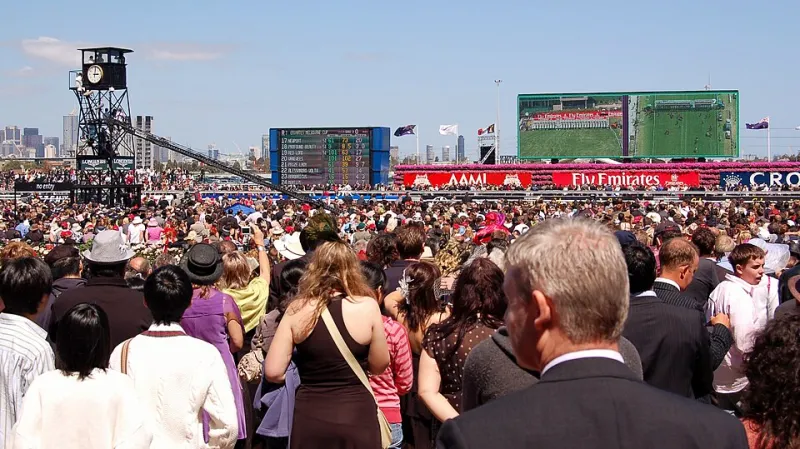
Photo: Bahnfrend, CC BY-SA 4.0, via Wikimedia Commons
The first Tuesday of November rolls around and suddenly everyone in Australia becomes an expert. Office sweeps are drawn, fascinator budgets are blown, and the form guide gets more reads than a best-selling novel. But here's the uncomfortable truth: most of the information Aussie punters obsess over in the lead-up to the Melbourne Cup is either misleading, misapplied, or just plain irrelevant to what actually happens over 3200 metres at Flemington.
This isn't a guide to the 'right' horse. It's a guide to asking better questions — the ones that actually matter when you're putting real money on the race that stops a nation.
Why the Form Guide Is Only Half the Story
Form guides are brilliant tools. In the right context. For a 1200-metre sprint on a dry track at Randwick, recent race times, finishing positions, and margins tell you a lot. But the Melbourne Cup is not that race.
It's a 3200-metre staying contest, run on a track notorious for its camber and its tendency to reward horses that settle beautifully in the middle of the field before unleashing a long, sustained run. The form guide will tell you a horse finished second at Caulfield. It won't tell you how it finished second — whether it was fighting hard from the front and barely held on, or whether it was still travelling comfortably and had more to give.
The race sectionals — the split times within a race — are far more illuminating than the final result. A horse that runs the last 600 metres of a prep race faster than the winner is often a horse that has been deliberately under-cooked. That's the kind of data worth hunting for.
Track Conditions: The Variable Everyone Underestimates
Flemington in early November can be anything. A dry, fast track. A rain-affected soft surface. Something in between. And the thing is, it genuinely matters — not just a little, but potentially the difference between a winner and a horse that finishes midfield.
Here's what to understand about ground preferences:
- European stayers — who make up a significant portion of the Cup field each year — often have extensive form on soft to heavy ground. British and Irish tracks are frequently wet. If Flemington gets a soaking before Cup day, those horses may actually be more comfortable than their Australian counterparts.
- Horses with form exclusively on fast tracks need to be viewed with caution if the forecast turns wet. Their peak performances may never have been tested on a yielding surface.
- Check the horse's entire racing history, not just their last three starts. Ground preferences can be buried deep in a horse's record and are often ignored in the mainstream coverage.
In 2023, the track came up soft. In 2022, it was good. Conditions vary every year, and the horses that adapt best — not just the ones in best current form — tend to run well.
The Jockey Factor: More Than Just Name Recognition
During Cup week, the narrative gravitates toward the star jockeys. And yes, talent matters. But at 3200 metres with a field of 24, the Cup is won and lost in the first 800 metres — specifically in how a jockey finds a position without using too much of their horse's energy.
The riders worth studying are those with:
- Strong Cup-specific records — some jockeys simply understand Flemington's unique demands better than others. Look at their historical results at the track and distance, not just their overall win percentages.
- Experience managing big fields — the early stages of the Cup are chaotic. Horses get shuffled back, others get trapped wide. Jockeys who stay calm and find cover without panicking are at a premium.
- Recent Flemington form — a jockey who has ridden at the track during the Spring Carnival in the weeks before the Cup has a feel for how the surface is playing. That's not nothing.
International Form: The Translation Problem
The Cup typically draws a handful of European raiders, and they generate enormous market interest — often more than their actual chances warrant. But equally, they're sometimes dismissed too quickly by punters who can't assess form from tracks they've never seen.
The key is understanding race equivalence. A Group 1 win in Europe is not automatically comparable to a Group 1 win in Australia. Consider:
- Field quality: Some European staying races attract small, weak fields. A dominant win over six rivals at a provincial track is not the same as a competitive finish in the Caulfield Cup.
- Weight carried: The Melbourne Cup's handicapping system means top-weighted horses — often the European raiders who've won big races — carry significant weights. Check how a horse has performed under heavy impost before assuming their best form translates directly.
- Travel and acclimatisation: Horses that arrive in Australia six or more weeks before the Cup and have had a prep run locally are in a fundamentally different position to those that arrive ten days before the race. The time zone, the food, the track surface — it all takes adjustment.
What the Spring Carnival Hype Gets Wrong
Cup week is a media spectacle, and that spectacle distorts the market. Horses that receive heavy media coverage — whether because of a famous trainer, a popular jockey, or a compelling backstory — attract public money that shortens their price regardless of their actual winning chances.
This is where the average Aussie punter can find genuine value. The horses that win the Melbourne Cup are not always the ones on the front page of the Herald Sun on Monday morning. Historically, the race has a strong record of producing winners from the middle of the market — horses priced between $10 and $25 — rather than the $4 or $5 favourites who carry all the publicity.
Look for horses that:
- Have quietly improved across their prep without attracting headlines
- Have a trainer with a strong Flemington strike rate who's said very little publicly
- Are drawn in a middle barrier (avoiding the wide draws that force energy-sapping early runs)
- Have a clean health record through their preparation with no interrupted training
A Practical Framework for Cup Day
Rather than backing one horse and hoping, consider structuring your Cup betting around a few key principles:
- Identify your contenders first using the factors above — ground preference, jockey form, realistic weight assessment, and barrier.
- Assess the market for where the value sits. If your top pick is $8 and you think they have a genuine 15-20% chance, that's worth a bet. If they've been backed into $4.50 purely on hype, step away.
- Use each-way betting thoughtfully. A place return on a $15-$20 shot that runs third is still a meaningful return. The Cup regularly throws up wide open finishes where multiple longshots fill the placings.
- Set a budget before you sit down and treat it as entertainment money. The Cup is brilliant fun — but it's one race, and even the best analysis doesn't guarantee a result.
The Bottom Line
The Melbourne Cup is one of the most fascinating betting puzzles in Australian sport precisely because it's so easy to get wrong in so many different ways. The horse with the best recent form doesn't always win. The favourite rarely salutes. The horse nobody's talking about at the office on Monday often finishes in the first four.
Do the work that others won't — study the ground, understand the jockey, and translate the international form properly. That's not a guarantee, but it's a much better foundation than picking the horse with the prettiest name on your sweep ticket.
Good luck on Cup day. May your read be sharper than the field.